Please select your country below to view the products, information, and services available in your location, including news, promotions, events, and more.
en-usLUSNYI15PCRPCR (Polymerase Chain Reaction)/webroot/web/html/lsr/solutions/technologies/pcr/webroot/web/images/lsr/solutions/technologies/gene_expression/pcr/technology_detail/pcr-feature.jpg/webroot/web/images/lsr/solutions/technologies/gene_expression/technology_thumb/cat_gxt1_pcr_icon.jpgPhoto of Bio-Rad PCR thermal cyclers<script type="text/javascript">// <![CDATA[
$('head').append('<meta name="DCSext.at_banner" content="PCR" /><meta name="DCSext.at_banner_e"
content="v" />');
$(document).ready(function () {
$('#relatedProducts').appendTo('#rightcol');
});
// ]]></script>
<div id="relatedProducts">
<div id="rightcolcontent">
<div id="rightcolcontenttop"><span class="rightcolumn_header">Related Products</span>
<div class="line-divider"> </div>
</div>
<div id="rightcolcontentmid">
<div class="image-link-mod"><a onmousedown="Webtrends.multiTrack({element:this, argsa:['DCSext.at_related_products','C1000
Touch Thermal Cycler','DCSext.at_related_products_url',location.hostname + location.pathname,'WT.dl','99999'],delayTime:250});"
href="/en-us/product/thermal-cyclers-for-pcr/c1000-touch-thermal-cycler"> <img src="/webroot/web/images/lsr/solutions/technologies/digital_pcr/thumb-c1000.png"
alt="C1000 Touch Thermal Cycler" /> </a><a onmousedown="Webtrends.multiTrack({element:this,
argsa:['DCSext.at_related_products','C1000 Touch Thermal Cycler','DCSext.at_related_products_url',location.hostname
+ location.pathname,'WT.dl','99999'],delayTime:250});" href="/en-us/product/thermal-cyclers-for-pcr/c1000-touch-thermal-cycler">C1000
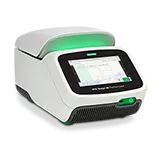
Touch™ Thermal Cycler</a></div>
<div class="line-divider"> </div>
<div class="image-link-mod"><a onmousedown="Webtrends.multiTrack({element:this, argsa:['DCSext.at_related_products','T100
Thermal Cycler','DCSext.at_related_products_url',location.hostname + location.pathname,'WT.dl','99999'],delayTime:250});"
href="/en-us/product/t100-thermal-cycler"> <img src="/webroot/web/images/lsr/solutions/technologies/digital_pcr/thumb-t100.png"
alt="T100 Thermal Cycler" /> </a><a onmousedown="Webtrends.multiTrack({element:this,
argsa:['DCSext.at_related_products','T100 Thermal Cycler','DCSext.at_related_products_url',location.hostname
+ location.pathname,'WT.dl','99999'],delayTime:250});" href="/en-us/product/t100-thermal-cycler">T100™
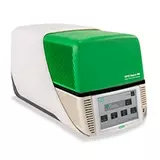
Thermal Cycler</a></div>
<div class="line-divider"> </div>
<div class="image-link-mod"><a onmousedown="Webtrends.multiTrack({element:this, argsa:['DCSext.at_related_products','PCR/qPCR
Reagents','DCSext.at_related_products_url',location.hostname + location.pathname,'WT.dl','99999'],delayTime:250});"
href="/en-us/category/pcr-reagents-qpcr-reagents"> <img src="/webroot/web/images/lsr/solutions/technologies/digital_pcr/thumb-pcr-master-mixes-kits.png"
alt="PCR/qPCR Reagents" /> </a><a onmousedown="Webtrends.multiTrack({element:this,
argsa:['DCSext.at_related_products','PCR/qPCR Reagents','DCSext.at_related_products_url',location.hostname
+ location.pathname,'WT.dl','99999'],delayTime:250});" href="/en-us/category/pcr-reagents-qpcr-reagents">PCR/qPCR
Reagents</a></div>
<div class="line-divider"> </div>
<div class="image-link-mod"><a onmousedown="Webtrends.multiTrack({element:this, argsa:['DCSext.at_related_products','PCR
Plates, Seals, and Tubes','DCSext.at_related_products_url',location.hostname + location.pathname,'WT.dl','99999'],delayTime:250});"
href="/en-us/category/pcr-plastic-consumables"> <img src="/webroot/web/images/lsr/solutions/technologies/digital_pcr/thumb-pcr-plates.png"
alt="PCR Plates, Seals, and Tubes" /> </a><a onmousedown="Webtrends.multiTrack({element:this,
argsa:['DCSext.at_related_products','PCR Plates, Seals, and Tubes','DCSext.at_related_products_url',location.hostname
+ location.pathname,'WT.dl','99999'],delayTime:250});" href="/en-us/category/pcr-plastic-consumables">PCR
Plates, Seals, and Tubes</a></div>
</div>
</div>
</div>
<p>Polymerase chain reaction (PCR) is a technique used to exponentially amplify a
specific target DNA sequence, allowing for the isolation, sequencing, or cloning of
a single sequence among many. PCR was developed in 1983 by Kary Mullis, who received
a Nobel Prize in chemistry in 1993 for his invention. The polymerase chain reaction
has been elaborated in many ways since its introduction and is now commonly used for
a wide variety of applications including genotyping, cloning, mutation detection,
sequencing, microarrays, forensics, and paternity testing.</p>
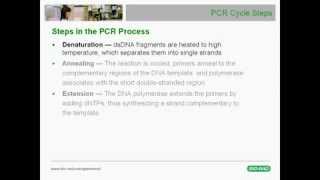
<p>Typically, a PCR is a three-step reaction. The sample containing a dilute concentration
of template DNA is mixed with a heat-stable DNA polymerase, such as Taq polymerase,
primers, deoxynucleoside triphosphates (dNTPs), and magnesium. In the first step of
PCR, the sample is heated to 95–98°C, which denatures the double-stranded
DNA, splitting it into two single strands. In the second step, the temperature is
decreased to approximately 55–65°C, allowing the primers to bind, or anneal,
to specific sequences of DNA at each end of the target sequence, also known as the
template. In the third step, the temperature is typically increased to 72°C, allowing
the DNA polymerase to extend the primers by the addition of dNTPs to create a new
strand of DNA, thus doubling the quantity of DNA in the reaction. This sequence of
denaturation, annealing, and extension is repeated for many cycles, resulting in the
exponential amplification of the template DNA. As the DNA polymerase loses activity
or the dNTPs and primers are consumed, the reaction rate reaches a plateau.</p>
<p>This section includes considerations for the proper <a href="/evportal/destination/solutions?catID=LUSO1VKG4">design
and optimization</a>, <a href="/evportal/destination/solutions?catID=LUSO2PESH">analysis</a>,
and <a href="/evportal/destination/solutions?catID=LUSO3HC4S">troubleshooting</a>
of polymerase chain reactions, as well as descriptions of the required PCR <a href="/evportal/destination/solutions?catID=LUSNZ1E8Z">instrumentation</a>
and <a href="/evportal/destination/solutions?catID=LUSO0V4VY">reagents</a>.</p>
Further Reading<p>Bagasra O et al. (1992). Detection of human immunodeficiency virus type 1 provirus
in mononuclear cells by in situ polymerase chain reaction. New Engl J Med 326, 1385–1391.
PMID: <a href="http://www.ncbi.nlm.nih.gov/pubmed/1569974" target="_blank" rel="noopener
noreferrer">1569974</a></p>
<p>de Bruijn MH (1988). Diagnostic DNA amplification: No respite for the elusive parasite.
Parasitol Today 4, 293–295. PMID: <a href="http://www.ncbi.nlm.nih.gov/pubmed/15463008"
target="_blank" rel="noopener noreferrer">15463008</a></p>
<p>Eckert KA and Kunkel TA (1993). DNA polymerase fidelity and the polymerase chain
reaction. PCR Methods Appl 1, 17–24. PMID: <a href="http://www.ncbi.nlm.nih.gov/pubmed/1842916"
target="_blank" rel="noopener noreferrer">1842916</a></p>
<p>Hayashi K (1994). PCR-SSCP analysis and its application to DNA diagnosis. Fukuoka
Igaku Zaashi 85, 74–77. PMID: <a href="http://www.ncbi.nlm.nih.gov/pubmed/1842918"
target="_blank" rel="noopener noreferrer">1842918</a></p>
<p>Higuchi R et al. (1988). A general method of in vitro preparation and specific
mutagenesis of DNA fragments: Study of protein and DNA interactions. Nucleic Acids
Res 16, 7351–7367. PMID: <a href="http://www.ncbi.nlm.nih.gov/pubmed/3045756"
target="_blank" rel="noopener noreferrer">3045756</a></p>
<p>Lee CC et al. (1988). Generation of cDNA probes directed by amino acid sequence:
Cloning of urate oxidase. Science 239, 1288–1291. PMID: <a href="http://www.ncbi.nlm.nih.gov/pubmed/3344434"
target="_blank" rel="noopener noreferrer">3344434</a></p>
<p>Mullis K et al. (1992). Specific enzymatic amplification of DNA in vitro: The polymerase
chain reaction. 1986. Biotechnology 4, 17–27. PMID: <a href="http://www.ncbi.nlm.nih.gov/pubmed/1422010"
target="_blank" rel="noopener noreferrer">1422010</a></p>
<p>Ochman H et al. (1988). Genetic applications of an inverse polymerase chain reaction.
Genetics 120, 621–623. PMID: <a href="http://www.ncbi.nlm.nih.gov/pubmed/2852134"
target="_blank" rel="noopener noreferrer">2852134</a></p>
<p>Wang Y et al. (2004). A novel strategy to engineer DNA polymerases for enhanced
processivity and improved performance in vitro. Nucleic Acids Res 32, 1197–1207.
PMID: <a href="http://www.ncbi.nlm.nih.gov/pubmed/14973201" target="_blank" rel="noopener
noreferrer">14973201</a></p>
<p>Welsh J and McClelland M (1990). Fingerprinting genomes using PCR with arbitrary
primers. Nucleic Acids Res 18, 7213–7218. PMID: <a href="http://www.ncbi.nlm.nih.gov/pubmed/2259619"
target="_blank" rel="noopener noreferrer">2259619</a></p>
<div class="top"><a href="#helptop">Back to Top</a></div>
<div class="videowrap">
<div class="videoImg"><a title="PCR Fundamentals" onclick="javascript:openElementOverlay('PCRfund');"
href="javascript:void(0);"><img style="width: 88px; height: 51px; border: 0px none;"
src="/webroot/web/images/lsr/support/tutorials/global/ov_pcr_fundamentals.jpg" alt=""
/></a></div>
<div class="videoDesc"><a title="PCR Fundamentals" onclick="javascript:openElementOverlay('PCRfund');"
href="javascript:void(0);"><br />PCR Fundamentals</a></div>
<div class="clear"> </div>
</div>
<div id="PCRfund" style="display: none;">
<div class="overlay_contents" style="height: 383px;">
<div class="overlay-head">PCR Fundamentals</div>
<iframe src="http://www.youtube.com/embed/GvD-jRsq4PA?version=3&rel=0&showinfo=0&theme=light&modestbranding=1&fs=1;wmode=transparent"
width="620" height="376"></iframe></div>
</div>
<div class="videowrap">
<div class="videoImg"><a title="Performing Fast PCR" onclick="javascript:openElementOverlay('perfFastpcr');"
href="javascript:void(0);"><img style="width: 88px; height: 51px; border: 0px none;"
src="/webroot/web/images/lsr/support/tutorials/global/ov_fast_pcr.jpg" alt="" /></a></div>
<div class="videoDesc"><br /><a title="Performing Fast PCR" onclick="javascript:openElementOverlay('perfFastpcr');"
href="javascript:void(0);">Performing Fast PCR</a></div>
<div class="clear"> </div>
</div>
<div id="perfFastpcr" style="display: none;">
<div class="overlay_contents" style="height: 383px;">
<div class="overlay-head">Performing Fast PCR</div>
<iframe src="http://www.youtube.com/embed/SllP12tJHe0?version=3&rel=0&showinfo=0&theme=light&modestbranding=1&fs=1;wmode=transparent"
width="620" height="376"></iframe></div>
</div>
<div class="videowrap vwrap_last">
<div class="videoImg"><a title="From Plants to Sequences: A Six-Week College Biology
Lab Course" href="http://asp8.centra.com/main/Customers/bioradevents/Registrar/NewRegistration.jsp?event_id=00000000f6ac0b01185bfdace60079fe&locale=en_US&source=LSG_webinar_page"
target="_blank" rel="noopener noreferrer"><img style="border: none;" src="/webroot/web/images/lsr/support/tutorials/global/6weeks_plants.jpg"
alt="" /></a></div>
<div class="videoDesc"><a title="From Plants to Sequences: A Six-Week College Biology
Lab Course" href="http://asp8.centra.com/main/Customers/bioradevents/Registrar/NewRegistration.jsp?event_id=00000000f6ac0b01185bfdace60079fe&locale=en_US&source=LSG_webinar_page"
target="_blank" rel="noopener noreferrer">From Plants to Sequences: A Six-Week College
Biology Lab Course</a><br /> In this free web conference, teachers share their experience
in the classroom using the Cloning and Sequencing Explorer Series for student research
developed in collaboration with Bio-Rad Laboratories.</div>
<div class="clear"> </div>
</div>
Eddie CPCR (Polymerase Chain Reaction)Learn how PCR works, how to choose the right PCR instrument, how to design, optimize,
analyze, and troubleshoot PCR assays.
pcr, polymerase chain reaction, pcr analysis, primer design, troubleshooting, pcr
instruments, pcr reagents
12/22/11 09:16 AM12/22/21 09:44 AMAE,AI,AL,AM,AR,AT,AU,AZ,BA,BD,BE,BF,BG,BH,BN,BO,BR,BW,CA,CH,CL,CM,CN,CO,CR,CY,CZ,DE,DK,DO,DZ,EC,EE,EG,EH,ER,ES,ET,FI,FM,FO,FR,GA,GE,GF,GH,GP,GR,GT,GU,HK,HN,HR,HT,HU,ID,IE,IL,IN,IS,IT,JM,JO,JP,KE,KH,KR,KW,KZ,LB,LI,LK,LT,LU,LV,MA,MD,MG,MK,ML,MO,MQ,MS,MT,MU,MX,MY,NG,NI,NL,NO,NP,NZ,OM,PA,PE,PF,PG,PH,PK,PL,PR,PS,PT,PW,PY,QA,RO,RS,RU,SA,SB,SE,SG,SI,SK,SN,ST,SV,TG,TH,TN,TO,TR,TT,TW,TZ,UA,UG,UK,US,UY,UZ,VA,VE,VU,XK,YE,ZA,VNenLSR/LSR/Technologies/PCRN0PCR Instrumentation
/en-us/applications-technologies/applications-technologies/pcr-instrumentation?ID=LUSNZ1E8Z
Introduction to PCR Reagents and Purification
/en-us/applications-technologies/applications-technologies/introduction-pcr-reagents-purification?ID=LUSO0V4VY
PCR Assay Design and Optimization
/en-us/applications-technologies/applications-technologies/pcr-assay-design-optimization?ID=LUSO1VKG4
Introduction to PCR Analysis
/en-us/applications-technologies/applications-technologies/introduction-pcr-analysis?ID=LUSO2PESH
PCR Troubleshooting
/en-us/applications-technologies/applications-technologies/pcr-troubleshooting?ID=LUSO3HC4S
Technologies
/en-us/applications-technologies/applications-technologies/pcr-polymerase-chain-reaction?ID=LUSLZJC4S
LUSNYI15[x-forwarded-proto] = [https]
[accept-language] = [en-US]
[x-forwarded-port] = [443]
[x-forwarded-for] = [66.249.79.214, 10.232.3.166]
[accept] = [text/html,application/xhtml+xml,application/xml;q=0.9,*/*;q=0.8]
[seourl] = [/en-us/applications-technologies/pcr-polymerase-chain-reaction]
[x-amzn-trace-id] = [Root=1-5d8f04d6-c8977aea11a7c2ccec37c1ec]
[x-forwarded-server] = [lsds-prod-s.br.aws-livesite.io]
[x-forwarded-host] = [www.bio-rad.com]
[x-query-string] = [ID=LUSNYI15]
[host] = [10.232.0.21:1776]
[x-request-uri] = [/en-us/applications-technologies/pcr-polymerase-chain-reaction]
[from] = [googlebot(at)googlebot.com]
[connection] = [Keep-Alive]
[accept-encoding] = [gzip,deflate,br]
[user-agent] = [Mozilla/5.0 (Linux; Android 6.0.1; Nexus 5X Build/MMB29P) AppleWebKit/537.36
(KHTML, like Gecko) Chrome/41.0.2272.96 Mobile Safari/537.36 (compatible; Googlebot/2.1;
+http://www.google.com/bot.html)]
AppTech/AppTechDetailspageStyleKeyinternet/solutions_subapplications-technologies/pcr-polymerase-chain-reactionLSRLUSNYI15PCRPCR (Polymerase Chain Reaction)/webroot/web/html/lsr/solutions/technologies/pcr/webroot/web/images/lsr/solutions/technologies/gene_expression/pcr/technology_detail/pcr-feature.jpg/webroot/web/images/lsr/solutions/technologies/gene_expression/technology_thumb/cat_gxt1_pcr_icon.jpgPhoto of Bio-Rad PCR thermal cyclers<script type="text/javascript">// <![CDATA[
$('head').append('<meta name="DCSext.at_banner" content="PCR" /><meta name="DCSext.at_banner_e"
content="v" />');
$(document).ready(function () {
$('#relatedProducts').appendTo('#rightcol');
});
// ]]></script>
<div id="relatedProducts">
<div id="rightcolcontent">
<div id="rightcolcontenttop"><span class="rightcolumn_header">Related Products</span>
<div class="line-divider"> </div>
</div>
<div id="rightcolcontentmid">
<div class="image-link-mod"><a onmousedown="Webtrends.multiTrack({element:this, argsa:['DCSext.at_related_products','C1000
Touch Thermal Cycler','DCSext.at_related_products_url',location.hostname + location.pathname,'WT.dl','99999'],delayTime:250});"
href="/en-us/product/thermal-cyclers-for-pcr/c1000-touch-thermal-cycler"> <img src="/webroot/web/images/lsr/solutions/technologies/digital_pcr/thumb-c1000.png"
alt="C1000 Touch Thermal Cycler" /> </a><a onmousedown="Webtrends.multiTrack({element:this,
argsa:['DCSext.at_related_products','C1000 Touch Thermal Cycler','DCSext.at_related_products_url',location.hostname
+ location.pathname,'WT.dl','99999'],delayTime:250});" href="/en-us/product/thermal-cyclers-for-pcr/c1000-touch-thermal-cycler">C1000
Touch™ Thermal Cycler</a></div>
<div class="line-divider"> </div>
<div class="image-link-mod"><a onmousedown="Webtrends.multiTrack({element:this, argsa:['DCSext.at_related_products','T100
Thermal Cycler','DCSext.at_related_products_url',location.hostname + location.pathname,'WT.dl','99999'],delayTime:250});"
href="/en-us/product/t100-thermal-cycler"> <img src="/webroot/web/images/lsr/solutions/technologies/digital_pcr/thumb-t100.png"
alt="T100 Thermal Cycler" /> </a><a onmousedown="Webtrends.multiTrack({element:this,
argsa:['DCSext.at_related_products','T100 Thermal Cycler','DCSext.at_related_products_url',location.hostname
+ location.pathname,'WT.dl','99999'],delayTime:250});" href="/en-us/product/t100-thermal-cycler">T100™
Thermal Cycler</a></div>
<div class="line-divider"> </div>
<div class="image-link-mod"><a onmousedown="Webtrends.multiTrack({element:this, argsa:['DCSext.at_related_products','PCR/qPCR
Reagents','DCSext.at_related_products_url',location.hostname + location.pathname,'WT.dl','99999'],delayTime:250});"
href="/en-us/category/pcr-reagents-qpcr-reagents"> <img src="/webroot/web/images/lsr/solutions/technologies/digital_pcr/thumb-pcr-master-mixes-kits.png"
alt="PCR/qPCR Reagents" /> </a><a onmousedown="Webtrends.multiTrack({element:this,
argsa:['DCSext.at_related_products','PCR/qPCR Reagents','DCSext.at_related_products_url',location.hostname
+ location.pathname,'WT.dl','99999'],delayTime:250});" href="/en-us/category/pcr-reagents-qpcr-reagents">PCR/qPCR
Reagents</a></div>
<div class="line-divider"> </div>
<div class="image-link-mod"><a onmousedown="Webtrends.multiTrack({element:this, argsa:['DCSext.at_related_products','PCR
Plates, Seals, and Tubes','DCSext.at_related_products_url',location.hostname + location.pathname,'WT.dl','99999'],delayTime:250});"
href="/en-us/category/pcr-plastic-consumables"> <img src="/webroot/web/images/lsr/solutions/technologies/digital_pcr/thumb-pcr-plates.png"
alt="PCR Plates, Seals, and Tubes" /> </a><a onmousedown="Webtrends.multiTrack({element:this,
argsa:['DCSext.at_related_products','PCR Plates, Seals, and Tubes','DCSext.at_related_products_url',location.hostname
+ location.pathname,'WT.dl','99999'],delayTime:250});" href="/en-us/category/pcr-plastic-consumables">PCR
Plates, Seals, and Tubes</a></div>
</div>
</div>
</div>
<p>Polymerase chain reaction (PCR) is a technique used to exponentially amplify a
specific target DNA sequence, allowing for the isolation, sequencing, or cloning of
a single sequence among many. PCR was developed in 1983 by Kary Mullis, who received
a Nobel Prize in chemistry in 1993 for his invention. The polymerase chain reaction
has been elaborated in many ways since its introduction and is now commonly used for
a wide variety of applications including genotyping, cloning, mutation detection,
sequencing, microarrays, forensics, and paternity testing.</p>
<p>Typically, a PCR is a three-step reaction. The sample containing a dilute concentration
of template DNA is mixed with a heat-stable DNA polymerase, such as Taq polymerase,
primers, deoxynucleoside triphosphates (dNTPs), and magnesium. In the first step of
PCR, the sample is heated to 95–98°C, which denatures the double-stranded
DNA, splitting it into two single strands. In the second step, the temperature is
decreased to approximately 55–65°C, allowing the primers to bind, or anneal,
to specific sequences of DNA at each end of the target sequence, also known as the
template. In the third step, the temperature is typically increased to 72°C, allowing
the DNA polymerase to extend the primers by the addition of dNTPs to create a new
strand of DNA, thus doubling the quantity of DNA in the reaction. This sequence of
denaturation, annealing, and extension is repeated for many cycles, resulting in the
exponential amplification of the template DNA. As the DNA polymerase loses activity
or the dNTPs and primers are consumed, the reaction rate reaches a plateau.</p>
<p>This section includes considerations for the proper <a href="/evportal/destination/solutions?catID=LUSO1VKG4">design
and optimization</a>, <a href="/evportal/destination/solutions?catID=LUSO2PESH">analysis</a>,
and <a href="/evportal/destination/solutions?catID=LUSO3HC4S">troubleshooting</a>
of polymerase chain reactions, as well as descriptions of the required PCR <a href="/evportal/destination/solutions?catID=LUSNZ1E8Z">instrumentation</a>
and <a href="/evportal/destination/solutions?catID=LUSO0V4VY">reagents</a>.</p>
Further Reading<p>Bagasra O et al. (1992). Detection of human immunodeficiency virus type 1 provirus
in mononuclear cells by in situ polymerase chain reaction. New Engl J Med 326, 1385–1391.
PMID: <a href="http://www.ncbi.nlm.nih.gov/pubmed/1569974" target="_blank" rel="noopener
noreferrer">1569974</a></p>
<p>de Bruijn MH (1988). Diagnostic DNA amplification: No respite for the elusive parasite.
Parasitol Today 4, 293–295. PMID: <a href="http://www.ncbi.nlm.nih.gov/pubmed/15463008"
target="_blank" rel="noopener noreferrer">15463008</a></p>
<p>Eckert KA and Kunkel TA (1993). DNA polymerase fidelity and the polymerase chain
reaction. PCR Methods Appl 1, 17–24. PMID: <a href="http://www.ncbi.nlm.nih.gov/pubmed/1842916"
target="_blank" rel="noopener noreferrer">1842916</a></p>
<p>Hayashi K (1994). PCR-SSCP analysis and its application to DNA diagnosis. Fukuoka
Igaku Zaashi 85, 74–77. PMID: <a href="http://www.ncbi.nlm.nih.gov/pubmed/1842918"
target="_blank" rel="noopener noreferrer">1842918</a></p>
<p>Higuchi R et al. (1988). A general method of in vitro preparation and specific
mutagenesis of DNA fragments: Study of protein and DNA interactions. Nucleic Acids
Res 16, 7351–7367. PMID: <a href="http://www.ncbi.nlm.nih.gov/pubmed/3045756"
target="_blank" rel="noopener noreferrer">3045756</a></p>
<p>Lee CC et al. (1988). Generation of cDNA probes directed by amino acid sequence:
Cloning of urate oxidase. Science 239, 1288–1291. PMID: <a href="http://www.ncbi.nlm.nih.gov/pubmed/3344434"
target="_blank" rel="noopener noreferrer">3344434</a></p>
<p>Mullis K et al. (1992). Specific enzymatic amplification of DNA in vitro: The polymerase
chain reaction. 1986. Biotechnology 4, 17–27. PMID: <a href="http://www.ncbi.nlm.nih.gov/pubmed/1422010"
target="_blank" rel="noopener noreferrer">1422010</a></p>
<p>Ochman H et al. (1988). Genetic applications of an inverse polymerase chain reaction.
Genetics 120, 621–623. PMID: <a href="http://www.ncbi.nlm.nih.gov/pubmed/2852134"
target="_blank" rel="noopener noreferrer">2852134</a></p>
<p>Wang Y et al. (2004). A novel strategy to engineer DNA polymerases for enhanced
processivity and improved performance in vitro. Nucleic Acids Res 32, 1197–1207.
PMID: <a href="http://www.ncbi.nlm.nih.gov/pubmed/14973201" target="_blank" rel="noopener
noreferrer">14973201</a></p>
<p>Welsh J and McClelland M (1990). Fingerprinting genomes using PCR with arbitrary
primers. Nucleic Acids Res 18, 7213–7218. PMID: <a href="http://www.ncbi.nlm.nih.gov/pubmed/2259619"
target="_blank" rel="noopener noreferrer">2259619</a></p>
<div class="top"><a href="#helptop">Back to Top</a></div>
<div class="videowrap">
<div class="videoImg"><a title="PCR Fundamentals" onclick="javascript:openElementOverlay('PCRfund');"
href="javascript:void(0);"><img style="width: 88px; height: 51px; border: 0px none;"
src="/webroot/web/images/lsr/support/tutorials/global/ov_pcr_fundamentals.jpg" alt=""
/></a></div>
<div class="videoDesc"><a title="PCR Fundamentals" onclick="javascript:openElementOverlay('PCRfund');"
href="javascript:void(0);"><br />PCR Fundamentals</a></div>
<div class="clear"> </div>
</div>
<div id="PCRfund" style="display: none;">
<div class="overlay_contents" style="height: 383px;">
<div class="overlay-head">PCR Fundamentals</div>
<iframe src="http://www.youtube.com/embed/GvD-jRsq4PA?version=3&rel=0&showinfo=0&theme=light&modestbranding=1&fs=1;wmode=transparent"
width="620" height="376"></iframe></div>
</div>
<div class="videowrap">
<div class="videoImg"><a title="Performing Fast PCR" onclick="javascript:openElementOverlay('perfFastpcr');"
href="javascript:void(0);"><img style="width: 88px; height: 51px; border: 0px none;"
src="/webroot/web/images/lsr/support/tutorials/global/ov_fast_pcr.jpg" alt="" /></a></div>
<div class="videoDesc"><br /><a title="Performing Fast PCR" onclick="javascript:openElementOverlay('perfFastpcr');"
href="javascript:void(0);">Performing Fast PCR</a></div>
<div class="clear"> </div>
</div>
<div id="perfFastpcr" style="display: none;">
<div class="overlay_contents" style="height: 383px;">
<div class="overlay-head">Performing Fast PCR</div>
<iframe src="http://www.youtube.com/embed/SllP12tJHe0?version=3&rel=0&showinfo=0&theme=light&modestbranding=1&fs=1;wmode=transparent"
width="620" height="376"></iframe></div>
</div>
<div class="videowrap vwrap_last">
<div class="videoImg"><a title="From Plants to Sequences: A Six-Week College Biology
Lab Course" href="http://asp8.centra.com/main/Customers/bioradevents/Registrar/NewRegistration.jsp?event_id=00000000f6ac0b01185bfdace60079fe&locale=en_US&source=LSG_webinar_page"
target="_blank" rel="noopener noreferrer"><img style="border: none;" src="/webroot/web/images/lsr/support/tutorials/global/6weeks_plants.jpg"
alt="" /></a></div>
<div class="videoDesc"><a title="From Plants to Sequences: A Six-Week College Biology
Lab Course" href="http://asp8.centra.com/main/Customers/bioradevents/Registrar/NewRegistration.jsp?event_id=00000000f6ac0b01185bfdace60079fe&locale=en_US&source=LSG_webinar_page"
target="_blank" rel="noopener noreferrer">From Plants to Sequences: A Six-Week College
Biology Lab Course</a><br /> In this free web conference, teachers share their experience
in the classroom using the Cloning and Sequencing Explorer Series for student research
developed in collaboration with Bio-Rad Laboratories.</div>
<div class="clear"> </div>
</div>
Eddie CPCR (Polymerase Chain Reaction)Learn how PCR works, how to choose the right PCR instrument, how to design, optimize,
analyze, and troubleshoot PCR assays.
pcr, polymerase chain reaction, pcr analysis, primer design, troubleshooting, pcr
instruments, pcr reagents
12/22/11 09:16 AM12/22/21 09:44 AMAE,AI,AL,AM,AR,AT,AU,AZ,BA,BD,BE,BF,BG,BH,BN,BO,BR,BW,CA,CH,CL,CM,CN,CO,CR,CY,CZ,DE,DK,DO,DZ,EC,EE,EG,EH,ER,ES,ET,FI,FM,FO,FR,GA,GE,GF,GH,GP,GR,GT,GU,HK,HN,HR,HT,HU,ID,IE,IL,IN,IS,IT,JM,JO,JP,KE,KH,KR,KW,KZ,LB,LI,LK,LT,LU,LV,MA,MD,MG,MK,ML,MO,MQ,MS,MT,MU,MX,MY,NG,NI,NL,NO,NP,NZ,OM,PA,PE,PF,PG,PH,PK,PL,PR,PS,PT,PW,PY,QA,RO,RS,RU,SA,SB,SE,SG,SI,SK,SN,ST,SV,TG,TH,TN,TO,TR,TT,TW,TZ,UA,UG,UK,US,UY,UZ,VA,VE,VU,XK,YE,ZA,VNenLSR/LSR/Technologies/PCRN0
Please reenter your email address in the correct format.
Please enter your email address.
Your subscription information already exists, we will send you an email with specific instructions to manage your existing subscription profile.
To receive the latest news, promotions, and more, sign up for Bio-Rad updates by entering your email address below. You can elect to receive only the types of Bio-Rad communications that are of interest to you..
Sign Up for Bio-Rad Updates!
Enter your email address below to receive your choice of the latest news, promotions, and more.