

The Western Blot Doctor is a self-help guide that enables you to troubleshoot your western blotting problems. In this section, you can find solutions to problems with blot background signal.
Other sections in the Western Blot Doctor:
- Band Appearance Problems
- Blot Background Problems
- Signal Strength Problems
- Band Size and Pattern Problems
Problems and Solutions
Click on the thumbnail that is most representative of your own blot to discover the probable causes and find specific solutions to the problem.
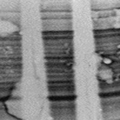
Problem: White spots or regions on blot
| White spots or white areas on the blot may be due to trapped air bubbles or unwetted membrane areas where protein will not bind. Both can be prevented with care. | 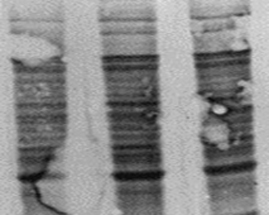 |
| Possible causes: | Solutions: |
| Improper assembly of transfer sandwich, trapped air bubbles |
|
| Overheated buffer |
|
| Dried out or improperly hydrated membrane |
See Blotting Membranes and Papers to learn more about the different types available and their properties |
Problem: High background on blot
| If you observe high background across the blot, there are a number of likely causes. Careful attention to your handling and protocol steps is required, and multiple trials may be necessary to resolve this problem. | 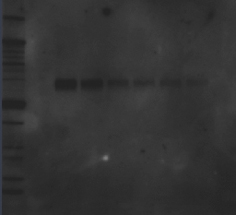 |
| Possible causes: | Solutions: |
| Incomplete blocking of membrane |
See Bio-Rad Detergents and Blocking Reagents
|
| Contaminated blocking reagent |
|
| Incubation with substrate for too long |
|
| Too much antibody |
|
| Contamination in incubation tray |
|
Problems specific to tank blotters:
(both may cause proteins to pass through blot and recirculate in buffer) |
|
| Antibody binding to proteins in blocking buffer (e.g., phosphospecific antibody binding casein or secondary antibody binding to blocking reagent) |
|
| Insufficient washing between incubation steps |
|
| Exposure too long |
|
| Membrane dried during blotting procedure incubation steps |
|
| Antibody activity loss due to long-term or improper storage |
|
| Incubation temperature too high |
|
| PVDF has higher background than nitrocellulose |
|
| Insufficient concentration of detergent in the buffers |
|
| Contaminated buffers |
|
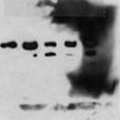
Problem: Blotchy or patchy background
| A blotchy background can be due to a dry membrane or insufficient washing; both problems are readily solved by ensuring that the blot is immersed at all times. Additional handling precautions should be taken to prevent accidental contamination from common laboratory sources. | 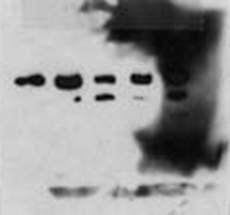 |
| Possible causes: | Solutions: |
| Uneven agitation during incubations |
|
| Parts of the membrane dried out |
|
| Contamination on blot |
|
| Insufficient access of washing or incubation buffer to areas of the blot |
|
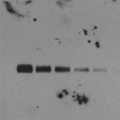
Problem: Uneven spots on blot or speckled background
| A speckled or spotty background can be caused by foreign material adhering to the membrane, antibody aggregation, or dirty scanner or cassette surfaces. All are preventable by fastidious handling procedures. | 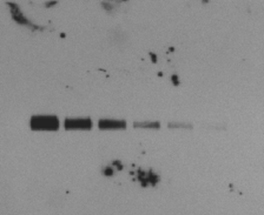 |
| Possible causes: | Solutions: |
| Aggregated secondary antibody |
|
| Antibodies binding to blocking reagent/clumps of blocking reagent stuck to membrane |
|
| Gel pieces stuck to membrane |
|
| Dirty scanner or cassette surfaces |
|
| Buffer contamination |
|
Problem: Gel cassette shadow transferred to blot (tank blotters)
| In cases of extended transfer, sometimes the user will observe the pattern of the transfer cassette plastic (or the pattern of the holes) on their blot. This problem is often attributable to the foam pads in the sandwich being too thin or having some sort of protein contamination. | 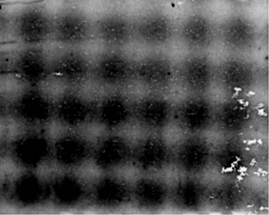 |
| Possible causes: | Solutions: |
| Foam pads are contaminated or too thin | |
| Excessive amount of protein loaded on gel (in a tank blotter, excess protein can pass through and recirculate in buffer) |
|
| Transfer buffer contaminated |
|