Every Lesson, a Discovery
Hands-On Labs That Make Science Unforgettable
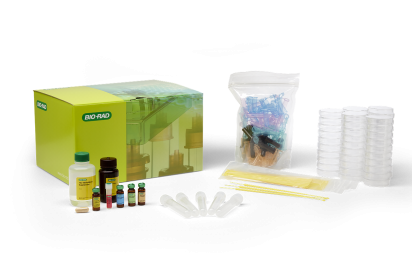
Bio-Rad Explorer Classroom Education Kits
Deepen Life Science Understanding Through Active Learning
Developed in partnership with educators and scientists, Bio‑Rad Explorer Kits make biology relevant, memorable, and fun. With Bio‑Rad's rigorous quality standards, award‑winning instructional resources, and expert guidance behind every kit, teachers can confidently deliver engaging, reliable lessons.
Find the Right Kit for Your Classroom
Filter Kits by:
Authentic CRISPR gene editing, this hands-on CRISPR-Cas9 lab lets students edit the lacZ gene in E. coli, producing a visible blue-to-white color change. The optional Genotyping Extension confirms edits via PCR and electrophoresis. |
Why do some become dependent on opioids while others don't? Students design a genetic study, run electrophoresis on pre-amplified DNA, and discover how dopamine receptor mutations influence addiction risk. |
Students extract DNA from their cheek cells and take it home in a keepsake necklace—a memorable introduction to molecular biology. |
Students analyze precut Lambda DNA fragments via gel electrophoresis to learn DNA mapping, restriction enzymes, and standard curve analysis. |
Students perform restriction enzyme digestion on Lambda DNA and analyze fragments via electrophoresis. |
Who did it? Students become forensic investigators, using restriction digestion and electrophoresis to match DNA evidence to suspects and solve a simulated crime. |
Students engineer a functional electrophoresis cell from scratch, learning both the science of DNA separation and hands-on engineering principles. |
Students explore electrophoresis using colored dyes to visualize molecular separation. |
Build a physical DNA model, ideal for teaching DNA structure at home or in the classroom. |
Students use PCR, gel electrophoresis, DNA seqencing, and bioinformatics to identify species for ecological projects or to detect "food fraud". |
Students extract their own DNA and use PCR to detect the PV92 Alu insertion, a genetic marker that varies across populations. Calculate allele frequencies, explore Hardy-Weinberg equilibrium, and spark discussions about human ancestry and genetic diversity. |
Turn your classroom into a crime lab! Students become forensic scientists, using PCR and gel electrophoresis to analyze DNA evidence and crack a simulated case. |
Engage students in GMO detection using real grocery store food. Students extract DNA, amplify via PCR, and run electrophoresis to identify GMO sequences. Supports bioethics discussions. |
Teach real-time PCR and compare the results to conventional PCR using premade DNA samples. Avoid the variables associated with DNA extraction and sample preparation. |
How much of your students' favorite snacks are genetically modified? Teach the entire real-time quantitative PCR (qPCR) workflow, from DNA extraction to data analysis. |
Watch bacteria glow green! Students transform E. coli with the pGLO plasmid to express jellyfish GFP—a dramatic demonstration of the central dogma: DNA → RNA → Protein → Trait. |
The classic pGLO activity, but structured differently: students transform bacteria, select for antibiotic resistance, then design their own experiment to switch on GFP expression. Includes a biosensor design challenge. |
Five labs in one kit: start with the classic pGLO transformation, then guide students through inquiry investigations they design themselves. |
After pGLO transformation, students extract proteins and run SDS-PAGE to identify the single glowing band responsible for fluorescence. |
Purify the protein that makes bacteria glow. Students use hydrophobic interaction chromatography to isolate GFP from pGLO tranmsformants—watching the green band move through the column in real time. |
Turn your classroom into a biotech company. Students discover a medicinal protein, purify it, then navigate drug regulations, ethics, and marketing—experiencing the full product pipeline. |
Tackle world hunger in your classroom. Students use the Bradford assay to analyze protein content in store-bought drinks, then design a treatment proposal for malnutrition using engineering design principles. |
How much protein is in your students' favorite foods? Using the Bradford assay, students test milk, eggs, sports drinks—applying Beer's law and standard curves to quantify protein like real scientists. |
This versatile and reliable workhorse lab uses authentic reagents to teach hands-on ELISA. Choose to detect either antigen or antibody, and adapt the lab to myriad diagnostic, food safety, disease tracking, or custom scenarios. |
Put students in the role of conservation scientists! They use ELISA to detect pregnancy complications and predict ovulation in simulated panda samples, connecting immunology to ecology and species survival. |
Students assay cellobiase enzyme activity under different conditions to optimize biofuel production, exploring how mushrooms break down plant material into fermentable glucose. |
In this inquiry-driven dive into enzyme kinetics, sudents extract cellobiase from mushrooms, optimize reaction conditions, and design experiments connecting biochemistry to ecology and biofuel engineering. |
Students use size exclusion chromatography to visualize the separation of colored proteins by molecular weight—an accessible introduction to purification techniques. |
Students run SDS-PAGE on fish muscle proteins to compare species and construct cladograms—connecting protein structure to evolution. |
Students use western blotting and immunodetection to pinpoint specific proteins, exploring how antibodies identify targets among hundreds of protein bands. |
Students observe photosynthesis and cellular respiration simultaneously using algae beads, then design experiments to determine which process dominates under different conditions. |
Students use premade, reliable, reusable algae beads to observe color changes as photosynthesis and respiration shift—an accessible entry to energy transformations. |
Even worms can learn. Students observe C. elegans development, "teach" worms to associate salt with food, then test how a mutation affects learning and chemotaxis behavior. |
Students use Koch's postulates to identify the microbe causing "Yogurtness" in milk—exploring microbiology, culturing techniques, and the dual roles of bacteria. |
In this multi-week research journey, students extract plant DNA, clone a gene, sequence it, and contribute original data to a bioinformatics database—mirroring real genomics workflows. |
Students experience biomanufacturing firsthand as they express, purify, and analyze recombinant DHFR protein using affinity chromatography, gaining skills directly applicable to industry careers. |
Track a viral outbreak! Students use DNA electrophoresis to trace how a simulated virus spread through a restaurant—connecting molecular techniques to a public health investigation. |
See cell communication! Students explore quorum sensing in Vibrio bacteria, witnessing bioluminescence as cells "talk" and trigger gene expression. Connects signal transduction to real-world applications. |
Interested in Talking with an Expert?
Contact a sales specialist to learn more.
FAQs
Explorer Kits span high school, career and technical education (CTE), community college, and university courses. A smaller selection of kits may also be a good fit for middle school science classrooms. Use the selector above to find the kits appropriate to your course or topic.
No. Explorer Kits are designed to work with standard laboratory equipment and do not require Bio-Rad-branded instruments. Some kits do not require specialized equipment at all. For classrooms that need equipment, Bio-Rad offers a full range of research-grade laboratory tools, including micropipets, electrophoresis systems, thermal cyclers, and other supplies, with education discounts available for classrooms building or expanding their labs.
Yes. Bio-Rad has an education discount policy for K–12 and college classrooms. Eligible Explorer Kits, equipment, and reagents are marked with an “EDU” price. To access educator pricing, you'll need to set up a free education account with Bio-Rad, after which discounted pricing is displayed automatically on the site (or in a personalized quote).
Go Further
Explorer Kits are just the beginning. Discover Bio-Rad's complete collection of classroom education products, including lab equipment, teaching resources, and hands-on learning tools that bring science concepts to life.