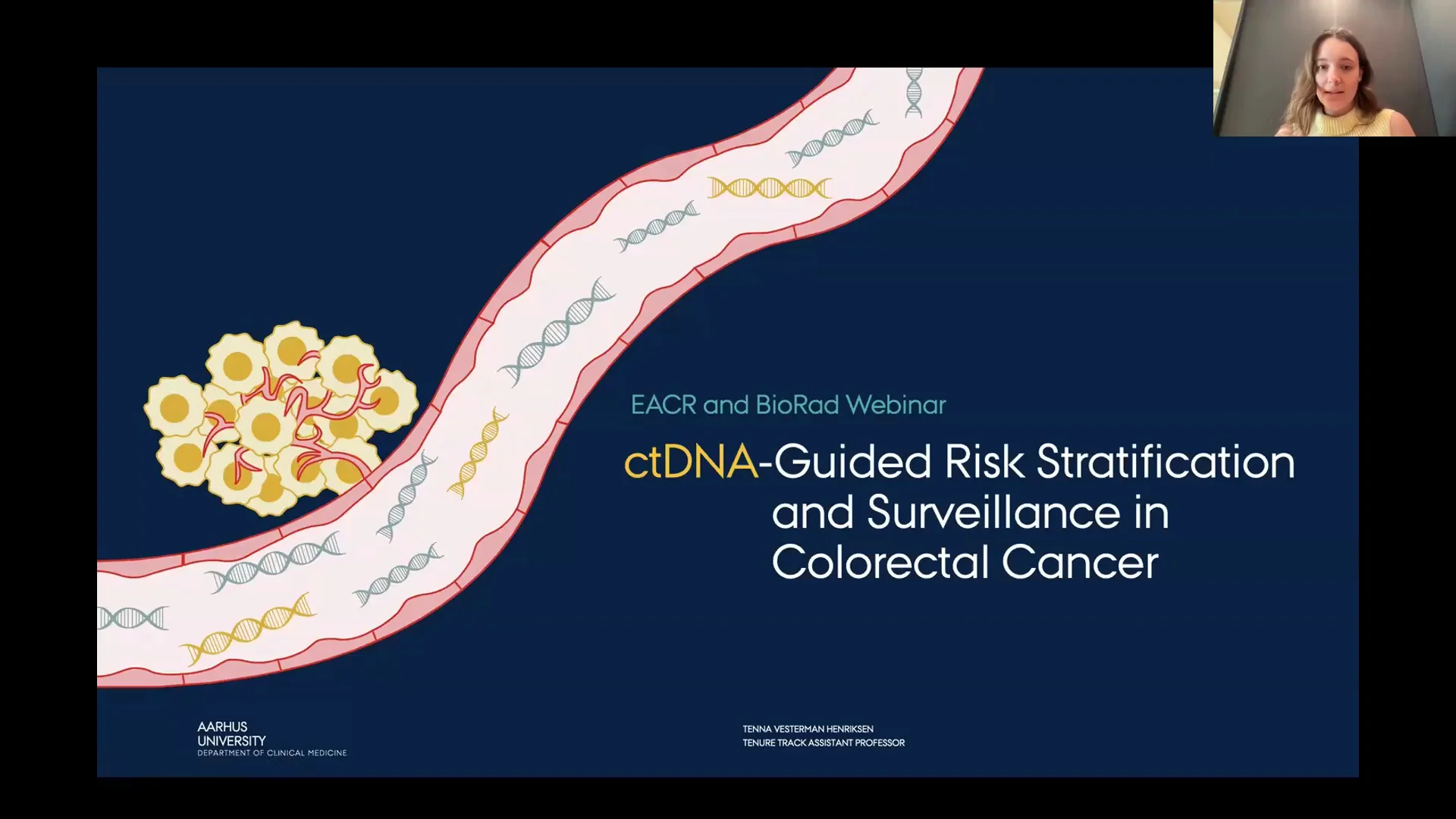


Watch On-Demand Webinar: ctDNA-Guided Risk Stratification and Surveillance in Colorectal Cancer
Current management of colorectal cancer relies heavily on histopathological risk factors, which are indirect measures of recurrence risk and can lead to imprecise treatment strategies.
In this on-demand EACR Industry Webinar, Tenna Vesterman Henriksen, PhD, discusses how circulating tumor DNA (ctDNA) analysis can provide a more direct measure of molecular residual disease (MRD), helping refine recurrence risk assessment and support earlier identification of relapse compared with conventional monitoring approaches.
Drawing on translational oncology research, this session explores how patient-specific Droplet Digital™ PCR (ddPCR™) assays can be used to monitor ctDNA over time and support more dynamic, data-informed surveillance strategies in colorectal cancer.
ctDNA offers a minimally invasive approach to directly measure MRD and monitor recurrence risk over time. In colorectal cancer, this has important implications for improving treatment stratification and surveillance beyond conventional histopathological assessment.
In this webinar, Dr. Henriksen demonstrates how tumor-informed ctDNA analysis can support more precise recurrence risk assessment by using whole-exome sequencing of the primary tumor to identify clonal mutations and design patient-specific ddPCR assays targeting a single mutation per patient. To ensure robustness in the MRD setting, assay performance is optimized by characterizing background noise, avoiding noise-prone variants, and prioritizing clonal mutations.
The session also explores how postoperative ctDNA detection may help distinguish patients at very high recurrence risk from those with substantially lower risk, and how intensive serial ctDNA monitoring may enable earlier relapse detection and improved understanding of tumor growth dynamics.
Key Takeaways
- How tumor-informed ctDNA analysis can refine recurrence risk assessment beyond conventional clinicopathological factors
- The role of ctDNA in postoperative MRD detection and risk stratification to inform treatment decisions
- How serial ctDNA monitoring may support earlier identification of recurrence compared to routine imaging, with emerging clinical evidence in colorectal cancer
- How patient-specific ddPCR assays can support sensitive ctDNA detection in translational oncology research
Who Should Watch
This webinar may be especially relevant for:
- Researchers working in precision oncology
- Scientists focused on ctDNA, liquid biopsy, and MRD research
- Translational researchers in colorectal cancer
- Teams interested in ddPCR and NGS integration
- Scientists developing or evaluating oncology molecular biology workflows
Why Watch On-Demand
Watch this session on your own schedule to learn how ctDNA-guided strategies are being explored to support more precise surveillance and risk assessment in colorectal cancer. Whether you are focused on translational research, assay development, or broader oncology workflows, this webinar provides practical scientific insight into a rapidly evolving area of precision oncology.
Speaker

Tenna Vesterman Henriksen, PhD
Assistant Professor, Department of Molecular Medicine, Aarhus University Hospital, Denmark