


How to Choose the Best Cell Sorter
7 Tips to Help you With Your Next Instrument Purchase
Presented here are some tips to help you avoid buyer's remorse and make an educated decision about which instrument to purchase. These tips provide you with the tools to make an informed decision when purchasing a cell sorter.
-

Define your needs.If you run a shared resource lab (SRL), then you'll want to start by querying the end users. What are their intended downstream applications? What cell types will they want to sort? If it's microparticles and bacteria, for example, you may require a more sensitive detector. If a lot of work is being done with the red fluorescent proteins, be sure to get a 532 or 561 nm laser. You will also need to be sure your users are comfortable sorting mammalian cells on an instrument that is also being used to sort microbes (e.g. yeast, bacteria, viruses, etc.)? Are any of the target cell populations rare? Combining this information onto an annotated list will allow you to triage needs versus wants and help you determine how many parameters (realistically) and at what event rates (in the case of rare cell types) will be required for sorting. If you are a shared resource lab, you may be worried about trying to accommodate every type of sorting request. But, after you've done your research, you may come to find that most of your users only need to sort GFP-expressing cells (e.g. enriching for positively transfected cells). If this is the case, then you will likely be better off purchasing a workhorse systems designed specifically for simple sorts. However, if a number of your users will require a high number of parameters for sorting (e.g. more than 10 colors), but you know you will also have a large number of 1-2 color sorting requests, then you may even want to consider what this stem cell core facility did, which was to purchase two different instruments with each dedicated for different sort requests. This way, you can make sure to maximize your resources and ensure that your lab is running as efficiently as possible.
If you are looking to purchase a cell sorter for a lab other than an SRL, then there's a different set of considerations to bear in mind. One of the most important is whether anyone in the lab has a flow cytometry background, or if your lab consists primarily of molecular biologists looking to take advantages FACS for the first time. Many cell sorting systems are incredibly sophisticated, have complex setup processes, and are controlled by equally complex software. The learning curve for these types of cell sorters is steep and will require a considerable time investment to learn to use. This is usually not be a problem if you run a shared resource facility with trained flow cytometry specialists that can operate and run user's sample on their behalf. But, if you are thinking of acquiring one of these more sophisticated instruments for your own lab, then you need consider who will be in charge of operating and maintaining the instrument. If your lab experiences a lot of turnover, then who will train the trainer? You don't want to find yourself in a situation where you no longer have a dedicated operator, ultimately resulting in experiments that rely on your cell sorter coming to a halt. If you think this might be the case, then you are likely better off with an instrument that has been designed for ease-of-use, such as the S3e Cell Sorter. Note that these kinds of systems can also be beneficial to SRLs that heavy training burden, or are experiencing instrument backlog due to too many simple sort requests (e.g. 1-2 parameters) from their user base.
While defining your needs seems like an obvious first step, having a crystal clear idea about what those needs actually are will end up saving you tens of thousands of dollars by making sure you don't pay for instrument features you'll never end up using.
-

Pay attention to instrument footprint: For many, bench space comes at a premium. So, you will want to make sure to get a full understanding of instrument's total footprint. Marketing materials from the different instrument manufactures often do not showcase every component of the instrument that's required for operation, For example, most cell sorters utilize an external pressure regulator or fluidics cart, both of which can be pretty bulky. Some instrument manufactures will also label their instrument as a benchtop cell sorter, but in actuality, are just as large as the other bulky sophisticated instrumentation. You may also need to look into whether the manufacturer offers a biosafety hood or cabinet and what the footprint is for this as well since these can also vary greatly in size.
-

Create a matrix of needs and wants. Once you have collected enough information about each system, it's time to list everything together into a tabular format for further comparison. By creating a matrix, you'll be able to see the whole picture, which will help you identify value that's otherwise hidden when you only consider price or number of lasers and detectors. For example, one area that is often overlooked is the total cost of ownership, which, for some instruments, will be much more demanding of your operational budget than others. The total cost of ownership not only factors in consumables (QC beads, sort-grade sheath, chip cartridges, etc.), with some consumable costs alone adding more than $25,000 to the purchase price over the life of the instrument (e.g. sorting chips or cartridges), but field support as well, including service costs and response time as well. Don't forget to factor in the time investments associated with having to train new users and what that kind of delay looks like with respect to your research progress. We have provided a matrix below, to help serve as an example for when it is time to create one of your own.
Instrument Max Number of Lasers Wavelength Max Number of FL Detectors Upgradeable in Field Event Rate,events/sec Nozzle Size (um) Footprint Price Operating Costs** A 1 488 nm 3 No 300 85 Small $ $$$ B 3 405, 488, 561, 640 nm 4 Yes 10,000 100 Small $ $ C 3 405, 488, 561, 638 nm 6 Yes 5,000* 70, 100, 130 Medium $$ $$$ D 3 405, 488, 561, 640 nm 9 Yes 5,000 100 Large $$$ $$ E 4 405, 488, 561, 638 nm 12 No 5,000* 70, 100 Large $$$$ $$ F 6 375, 405, 445, 488, 561, 633 nm 18 Yes 10,000* 75, 85, 100, 130 Large $$$$$ $ *with the 100 um chip
**Consumables, service contract, setup time, training -

Survey the market. You probably already have an idea of the "big" players in the market, but even if you don't, simply typing the query "flow cytometers" or "cell sorters" in your browser yields several different instrument manufacturers within the first two pages of a Google search. Follow these links and collect information about the various instruments. Use an electronic note-taking application, such as Evernote, to keep everything together, and make notes as you go through the process. For those websites where information and materials are not easily accessible, obtain marketing materials by sending an email to a local sales representative.
-

Learn how to read marketing materials. Instrument brochures usually list instrumentation specifications such as number of lasers and detectors. But, try to focus on other relevant information as well. This may include whether the instrument can be upgraded in the field, if they offer remote support to avoid an on-site service call or shorten the time for troubleshooting and repair by a field service engineer. This is also a good time to get a better understanding of the instrument manufacture's commitment to the field. Explore the website to see if they have invested in the development of resources such as online tools, how-to videos, protocols, and other tips or guides. This kind of content can go a long way in ensuring that you are successful at using their products and can be especially helpful if you are a lab that's new to FACS. Again, when you comes to locating this kind of information, don't be shy about emailing a local sales representative. Although their primary goal is to sell you an instrument, what they don't want is to sell you something that in the end you are not happy with. So, it's in their best interest to be as helpful as possible.
-

Take to social networks (being mindful of negative opinions). Once you think you've narrowed down your choices to one or two instruments, it's a good idea to reach out to the various flow cytometry message boards in order to get user feedback. You should also reach out to colleagues and other labs for their experience. Useful information that can come back from the community includes whether they're happy with their purchase, recurring hardware/software failures, maintenance issues, service issues, service response times, cost of ownership, etc. However, as with all message boards and customer reviews, try to be mindful of negative ones. Just as in real life, it's always those that are most dissatisfied that are the loudest. Even then, it's ok to bring any negative issues to the attention of the manufacturer (respecting people's confidentiality, of course) and ask for a response. Get everything in writing. Don't rely on phone conversations. If you're having trouble getting feedback, you can always go onto the manufactures site and look for customer testimonials. While it may seem like they are biased in their opinion, they are professionals and will be very upfront about any pros and cons with respect to the instrument.
-

Gain hands-on experience. Finally, most people would never buy a car without actually taking it for a test drive first and the same holds true when it comes to buying a cell sorter. So, before taking the plunge on an instrument purchase, make sure to get a hands-on demonstration. Some of the things to look out for are how long it takes to get the instrument up and running or how easy or difficult it is to learn to operate the system since this will be the same experience your users will have to go through. By running the instrument for yourself, you should be able to evaluate ease of use, how stable the software is, get a feel for the user interface, and instrument performance (e.g. purity, sorting speeds, etc.). Simply staining your favorite panel of antibodies and running them on the instrument will provide substantial information about how the instrument performs. However, it should be stressed that running real samples (not just beads) can be rather difficult and expectations should be tempered as real samples will likely require more optimization then the company's specialist likely has time for. This is especially true if there are any biohazard considerations associated with the sample you want to sort.
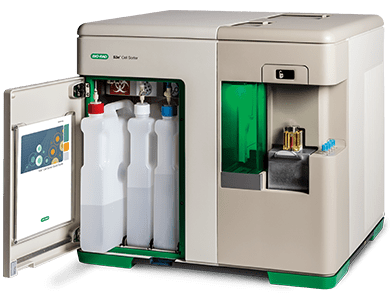
Your research is complex. The tools you use in the lab should not be. Driven by the desire to be your partner in flow cytometry, Bio-Rad is here to help accelerate your research by providing cell sorting solutions that meet the needs of all your users.
Starting to think about adding a cell sorter to the lab? Check out our Cell Sorter page to see how Bio-Rad can help you with your cell sorting needs.
Visit our Cell Sorter PageEvernote is a trademark of Evernote Corporation.