


Digital PCR
Absolute Quantification. No Calibration.
Introduction

New to Digital PCR?
Digital PCR (dPCR) is a method for the absolute quantification of DNA and RNA. Your sample is partitioned into thousands of individual reactions, and each is read as positive or negative for your target. Counting those partitions gives you an exact copy number, with no standard curve, no calibration, and no reliance on amplification efficiency.
That's what separates dPCR from qPCR: rather than determining quantity from Cq values and a standard curve, you count your target directly. It's what lets you resolve rare mutations, small fold changes, and low-abundance targets with confidence, even in samples that can challenge other methods.
Find the Right Tool for Your Question
The right tool depends on the question you're asking. Choose digital PCR if you're working with rare variants, small copy-number or expression changes, inhibitor-rich matrices, or applications requiring highly sensitive and reproducible quantification.
 |  |  | |
|---|---|---|---|
| qPCR | dPCR | NGS | |
| Quantification type | Relative quantification with a standard curve | Absolute quantification; target copies counted directly without a standard curve | Sequence information and relative abundance across many targets |
| Best for | Tracking well-characterized targets at routine sensitivity | Absolute quantification of rare, low-abundance, or inhibitor-rich samples | Discovering unknown variants or profiling many targets at once |
| Considerations | Fast and familiar; sensitivity may be limited for low-abundance targets | Fast and definitive for known targets; not built for open-ended discovery | Comprehensive, but typically higher cost and more complex workflows |
Droplet Digital™ PCR (ddPCR™) Technology
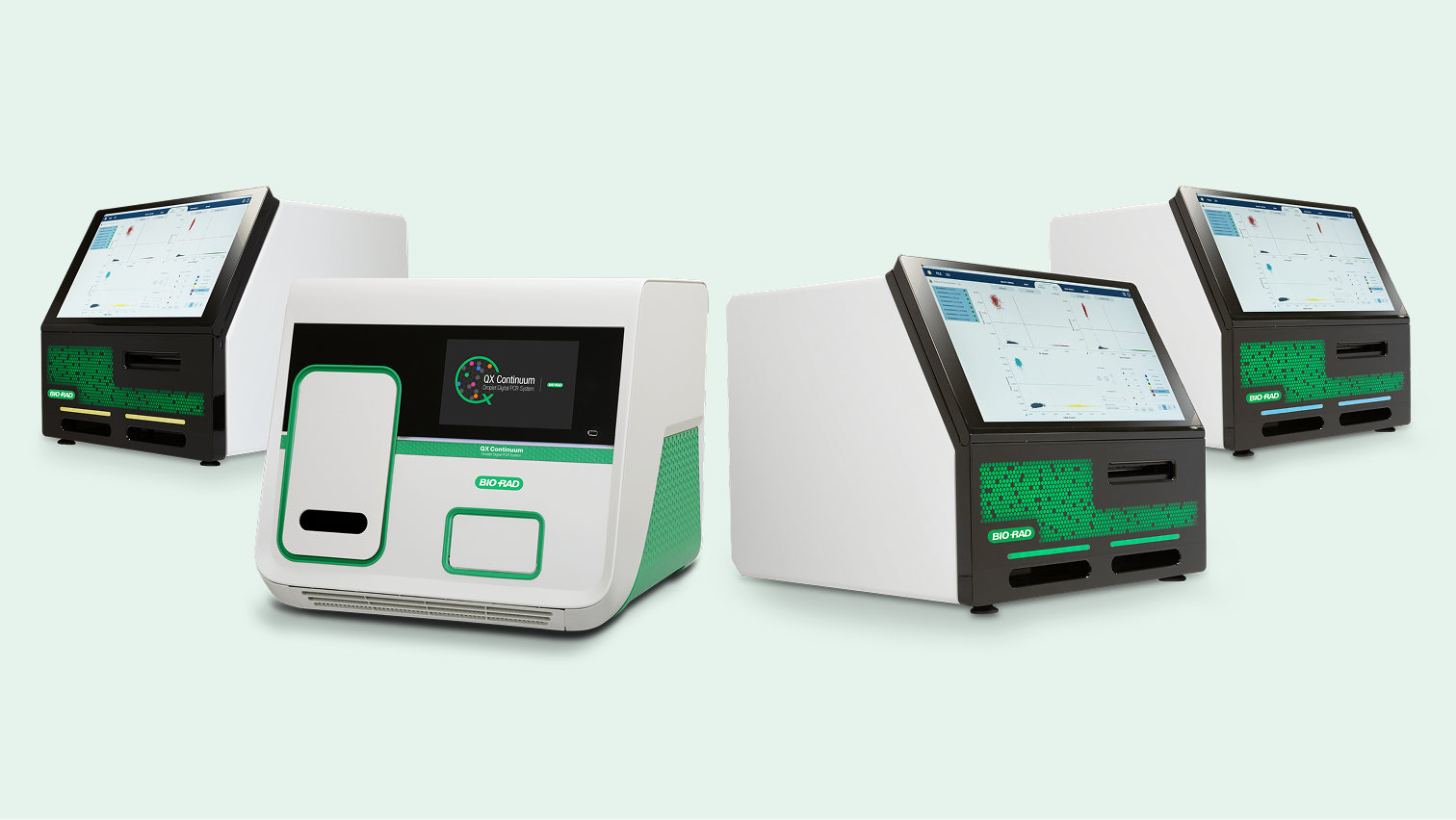
Explore Droplet Digital PCR (ddPCR) technology* for applications ranging from absolute quantification to orthogonal confirmation of NGS findings. Whether you're moving from qPCR or expanding your existing ddPCR workflow, our ddPCR solutions can help you take your research further.
*For Research Use Only. Not for use in diagnostic procedures.
- 8
ddPCR Systems
- 1,895+
wet-lab-validated assays
- 15+
applications supported
- 14
years of ddPCR innovation
Where ddPCR Solutions Move Your Field Forward

Oncology Research
Detect rare variants and quantify low-abundance circulating tumor DNA (ctDNA) to support sensitive oncology research applications.

Biopharma
Generate reproducible, copy-number measurements for cell and gene therapy and biologics research, including VCN, residual DNA, and viral titer.

Academic Research
Get absolute quantification from your most precious samples for applications including small fold-change detection, copy-number analysis, and genome-edit confirmation.

Environmental & Public Health
Quantify pathogen targets in challenging samples, including inhibitor-rich wastewater, using absolute quantification without a standard curve.
Explore ddPCR Resources

The Past, Present, and Future of Digital PCR
Download our ebook on the evolution of digital PCR.

Do You Know What Good Digital PCR Data Looks Like?
Learn more about data quality in digital PCR.

ddPCR Publications
Explore our database of ddPCR publications.

Digital PCR in Practice: Applications With Precision in Life Science and Manufacturing
Read our real-life ddPCR case studies.

Troubleshooting Tips
Find practical tips for troubleshooting common PCR issues and optimizing your results.
Connect With the ddPCR Community

Find out more about real-world ddPCR applications, emerging workflows, expert best practices, and the latest technology advances with ddPCR World, Bio-Rad's global Droplet Digital PCR event series. Attend online or in person at a venue near you.
FAQs
Digital PCR partitions a sample into many independent reactions, amplifies targets to endpoint, and counts positive and negative partitions to determine an absolute target count without a standard curve.
Droplet Digital PCR (ddPCR) technology is Bio-Rad's droplet-based implementation of digital PCR. It partitions each sample into tens of thousands of droplets, then counts positive and negative droplets after amplification to calculate absolute target concentration.
Digital PCR is the broader category of technologies that quantify nucleic acids by counting positive and negative reactions rather than tracking amplification in real time. ddPCR is one way of putting that principle into practice, using water-in-oil droplets as the partitions instead of, for example, microwell plates or chips. Because ddPCR technology can generate far more partitions per sample than many other digital PCR formats, it tends to offer better precision and sensitivity, particularly for detecting rare targets in a mixed population.
qPCR remains efficient for routine, high-volume relative quantification. However, when you need absolute quantification, are detecting rare or low-abundance targets, are resolving fold changes too small for reliable Ct discrimination, or are working in inhibitor-rich matrices, ddPCR has the advantage.
For broad, hypothesis-free discovery, NGS offers distinct advantages. However, once targets are defined, ddPCR technology quantifies them faster, at a lower cost per data point without a bioinformatics pipeline, and resolves variant allele frequencies below the practical sequencing depth. The technologies are also complementary: NGS can identify targets of interest, while ddPCR technology can support orthogonal confirmation and targeted quantification.
The quantification precision and dynamic range scale with the number of independent partitions. Splitting each sample into tens of thousands of droplets allows Poisson statistics to yield an absolute concentration estimate rather than a single bulk measurement.
In most cases, yes. The same primers and probes typically port to ddPCR solutions with minimal or no redesign, allowing you move to absolute quantification without rebuilding your assay library.
Applications benefit most from ddPCR when the answer has to be exact for a defined target. For example, rare mutation and variant detection, CNV, gene expression and miRNA, genome-edit validation, residual DNA and viral titer, library quantification, MRD/liquid biopsy monitoring, and wastewater/pathogen surveillance.